Thursday, March 17, 2011

Delete Me, I'm so Ugly | New text on Madness & Despair


Forty years ago, the Socialist Patients Collective, embarked on a project to turn illness into a weapon. To hold on to the fear and paranoia that dresses our despair in its most vibrant colors; to claim that experience as valid, and as the very condition on which modern capitalism reduces sense, claim bodies as its subjects, and functions to generalize alienation. The gun followed shortly.

Three stories separated by almost a century links the terror of woman. In Daldry's The Hours, Mrs. Dalloway lives and continues to reveal the tragedy of our world. There is nothing comforting that calls on the bodies marked dysfunctional to restrict their desire toward death. The body wants to fall, to submerge, to cough, to inhale the dark liquid and dissolve.

The house wife goes on strike, alone, acting as does the marginal factory or service worker. Stealing no longer keeps despair at bay; cheating can't bring back the years of doomed performances ahead. The future is always bleak. Addiction, a slow death. She drowns her children, she murders herself. She interrupts, in the most grotesque and elementary form, reproduction, and she assaults the meaning of this world. Minus one.

Madness, addiction, dysfunctional positionalities. I am terrified by the pen mark of the doctor, and of the indifference afforded to me by the consciously depressed. I want to make sense of it, but I can't. My texts, my speech, constantly acquiesce to the demand for rational discourse, molds into another author-function—disciplining her, and making room for me, and repeating the operation that gives encouragement to others who want to play with power. My experience drifting through twelve step programs will always remind me of a sense that there are those who want to hurt us, and then repair us. Who want to manage our despair, and reproduce the addicted-rock-bottom-body, the broken-mad-body, as a petri dish on which to make a different functional subject. While it's important not to equate madness with addiction, the scandal of these dysfunctional subjects is nevertheless similar. The sadness provoked by the realization that these experiences find analogous homes in what could be called an emotional commons requires unblinking eyes, and, in the days we can get out of bed, collective self-organization of care. Should it surprise anyone that this “care” has come and will come again in the form of “force?” We chose to publish Delete Me, I'm so Ugly in order to contribute to a reading of our times through the lens of despair, to hone in on the intelligence of madness, and to continue to ask “Of what does our congregation consist?”

Readable PDF

Imposed for Print PDF


Sunday, February 27, 2011

Poster & Comments on Wisconsin Anti-Austerity Struggle

Okay, We're weirded out as much as the next hater that Madison law-enforcement have joined the very nice occupation of WI capitol building, bringing their riot gear. If we wanted to be vulgar, we could say, well, so far the struggle's character is arguably captured in the image of what critical race theorists would say is "whiteness." However, it would clearly be a bit dishonest to say that's whole story. Nonetheless, the struggle, like other anti-austerity struggles stakes its claim on an image of past illusions restored: that of a working democracy, with liberal subjects contesting their value in the economy. Civil discourse in the labor of producing a "social" that is no longer tenable, and that defines the borders of inclusion in "civil society," which no longer can have borders. In content and in form, it has so far taken measures to extract and make invisible the naughty elements.

On the other hand, diffuse sick outs and doctors notes and international solidarity are a fascinating development. The fact that some have said "get a little bloody," might be part of the union bosses in the US falling into the same powerlessness as the CGT. Whereas it might be a threat of violence that no body who wants society to keep functioning actually wants to come to fruition, it might also reveal how this shit is so bad that the unions need to talk a big game. Eitherway, a funny thing happens when authoritative voices say it's okay to get wild and those who listen start to define their own parameters of force. All that being said, policing is a function that anyone who serves the concept of The People, and anyone who protects the flows of capital can perform. Cops, snitches, para-military, bosses, managers, citizen-arresters, military, fascists, blablabla. Optimism: What else could it mean when the uniformed subjects of this refuse their role? We can only hope those who will be at the decisive fault line understand their historical task.

So, General Strike eh? Sorel? Divine violence anybody?


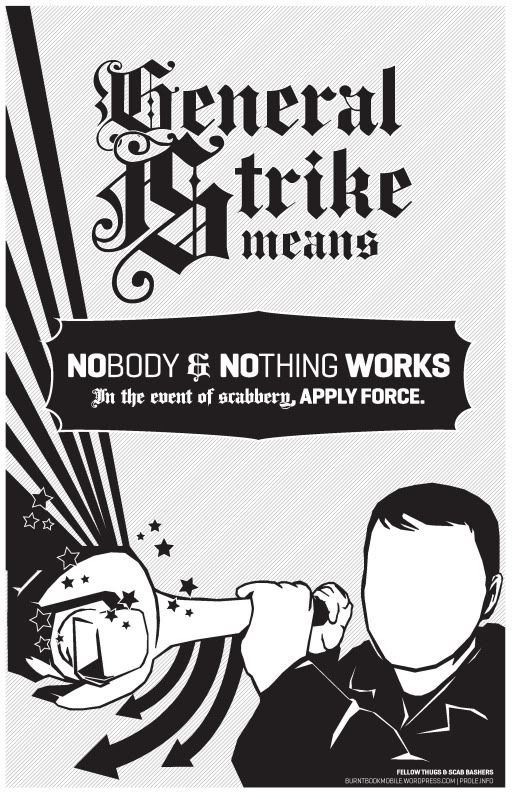
11x17 Poster

Saturday, February 5, 2011

Enemies We Know Poster Series


As proof that we are not merely the purveyor of false promises we submit to you, finally, the Enemies we know poster series. Sorry about the wait, but you did savor the anticipation, no?

Design

Each lovely piece of rhetoric is to be printed black and white on 11x17. We have taken care to adhere to certain design criticism, and believe we have achieved a quality result. The headings and drop caps are set in Pixture, a pixelated typeface referencing the centuries old Fraktur. We did this to make reference to the technological and cybernetic content of the posters—all this talk of “apparatuses.” The body text is set in Plexes Pro. We might live to regret this decision, but we think the humanistic warmness of Plexes doesn't subordinate its speaking power. Type decisions by our contemporaries attempt desperately to achieve a kind tone in order to make the short-attention span of a likely user forget she is looking at a piece of propaganda. We, on the other hand, will use the deceptive “I” statements to achieve a more subtle result. Plexes is undeniably “user-friendly,” but remains a disruptive internety text in it's strange “k.” Hopefully, our design decisions effect the results we'd like. If not, at least some citizen will be a little less cheerful when they experience the poster as if they were texting, “I've painted a world at peace that can only be described as war.


Identity

As we mentioned before, to cancel out, or add your own brand: Adobe Acrobat, Tools, Advanced Editing, Touch Up Object Tool/ Touch Up Text. Or whiteout or whatever.


Use

Walls, windows, your room, police cars, etc.


Oh yeah

If you see any of these shits posted around, and find yourself armed with camera, why not catch a couple flicks and send them our way.


Enemies We Know poster series


Intro (i.e RIP Democracy LOL)

Police

Bosses

Rapists


Mad love for the Asheville May Day Defendants, and the Egyptian proletarians

IEF | Cold-ass South | Winter '11

Friday, January 28, 2011

Belated Letters to Insurgents and Good Tidings | part 2

L. Desormais,

My never ending apologies for truant letters. The metropolitan trenches have this way of deepening my lack of faculties—making what words should come with ease into an endeavor all its own. Our congregation is so very far from the lovely scent of open conflicts. Still heeding the watchwords and making sense of the inspiring images and messages from distant lands, we lack the immediacy of speech. All of this makes communication remain a potentiality to be realized, rather than the result of the dispositions we take on during conflict. There is still a road ahead of us.

It's not difficult to understand or conceptualize a strategy of general withdrawal from production. What is bothersome remains the technical operations that follow this strategy, and the confusion surrounding the question “Of what does our congregation consist?” The answer to one informs the other. Understanding the makeup of our collectivities would give us insight in to both the questions of “What material resources, languages, and terrain do we already possess?” and “What role do we play in modern society?” What means we employ in order to withdraw from this role would be informed by the former question of what we already have at our disposal. I'm sure you can empathize—it's hard to know whether or not a collective should put its efforts into cheerleading the various protagonists that emerge in struggles that are geo-socially foreign—through means of revolutionary solidarity, public discussions, and general propaganda. Or if a collective owes it to the struggles taking place to seek out, make links and, with a careful hand, tie together the threads of a coherent active minority position that can itself contribute in its own unique way to the emergency situations when they come. One does not exclude the other—and it's best to simply wager and go for it—but I think a collective still must suss it out collectively in order to make the best wager.

You'll notice I don't mention the syndicalist, or big organization method. And though I'm sure you're familiar with critiques of unions, the left, etc, I want to put this argument to rest. Allow me to test my logic. It's not that I don't have a small yearning for the proletarian programs of the past, but as it stands no mass organization can resist the seduction of producing subjects, and no economic hypothesis can fathom a life without “the rule” and “value” as its basis. There can be no free labor when any attempt to free ourselves is limited by the process that created labor as such. Not to be such an art-douche, but forms do not exist in a vacuum. If all social forms are dominated (subsumed) by capital, no social form can be expected to generate a world free from capital. Furthermore, if we are in a period of capitalist valorization dominated by the process of producing capitalist content, then the fight is not happening primarily at the level of classical politics. Although we can see different social movements influence the policies of politicians and capitalists through legal and illegal means, we always see, in the same operations performed by these social movements, the realization of fully functioning capitalist democracies. This is why the fight is called “biopolitical,” because the war in progress takes place as conflicts over what lives are licit and illicit. This makes fomenting any real oppositional force a challenge because to be included or excluded is still to be perceived and incorporated. Would we prefer to be marked for death or for market research? We see the “protester” or “activist” take its rightful place among the loyal opposition, and we see the unions make abundantly clear just exactly what “the worker” identity has won us. We can't trust anything to wither away, but I don't think that means that we are irredeemably destined to experiment with failing forms. I think in the US in particular, because of how advanced the process of social dissolution and alienation, we are best suited to experiment with content—with what undocile means of living we find to arm us for withdraw from production. And this will always find itself antagonistic to mass organizations. If there is a dictatorship of the proletariat, or a strike as delimited as is capitalism, it will be anonymous and terrible.

Okay. As you can imagine, Obamafication in the US has not abolished the dark ages, and the citizens of this society keep hoping against hope for change. Curious, today the global north might be split on its feelings about the free flows of information. Wikileaks, rather than tuition costs—rather than meaningless labor and an equally meaningless “social life”—cause pause for alarm in this country. Don't get me wrong, I don't think that the autonomous elements of the information super highway are the state's only composite hostis, but I think the intelligence of these events shouldn't escape our gaze. The Obama campaign relied heavily on the free flow of information, incorporating the partisans of Web 2.0 into its troops. Today Obama's administration considers using military force against one of the recognized instruments of cyber political crime. One can imagine that those who hacked and attacked Visa and Mastercard as retribution for the arrest of Julian Assange and Brad Manning were also those who voted for hope and change. Someone asked if terrorism was the new paradigm of warfare, forgetting for a moment, that partisan forms have always also contained terror as their content. Today we're forced to consider what is the meaning of purely immaterial combat with material consequences? This is where I am not as well read in Baudrillard as I probably ought be.

After the spring, US anarchists felt their “we are winning” myth drift away. And with the loss of that myth, they also lost touch with the constellation of areas of revolt—the places, bodies, thoughts, and practices that generated a collective sense, or meaning. But once again we are reminded of how both the “we are winning,” and the “we have lost” myths are gaseous, and quickly dissolve without leaving any substance. Greek anarchists do what only the Greek anarchist can do. The French strikes reveal how the French areas of revolt are linked in a tactical feedback loop to Greece, to the US, to Iran, etc. England and the whole Green Isle flare up and remind us that history has not overlooked even the most panoptic societies. In Italy, the author-function literally becomes a shield to hide behind. I'm not interested in simply demanding that we keep finding inspiration in these events. To wave a flag and give backrubs when they are needed does not make a revolutionary force. Being faithful to history requires us to examine these events with suspicion and precision. What will it mean to communicate “we hear the call” each time civil war escapes its sovereign capture? To elaborate the piercing sound of revolt, and make it audible across the borders of identity and nation states. To not fall victim to the feeling that time is running out for us, but hold still the truth that even as we are repressed, it is a sign that time is running out for them.

In November, the FBI sent out a document regarding the domestic threat of “anarchist extremism.” Years before, they decided that ecological and animal liberation extremists were their public enemy. The image of detentions, deportations, and raids quickly arises. We've all felt the looming sense that Auschwitz never ended, and we've been reminded time and time again that this facility easily becomes a prison, this stadium easily transforms into a concentration camp. Katrina, New Orleans must not be forgotten, nor should September Eleven, Chile. Today, the deaths of eight squatters in New Orleans reminds us that Katrina was linked to the murder of the Lower East Side. Bordiga said that disasters were unplanned massacres in Capitalism—unplanned expenditure, where surplus labor was recycled. But fascism is not merely an extreme excess, it is an originary potency of sovereign power. The same operation that produces justice produces mass graves. How do we draw on this history? How does the image of starving ancestors give us strength when the enemy—who will accost even the dead—has never ceased to be victorious? I wonder if one of the defining operations of an insurrectional process in the US would be a constellation of actions that makes these historical tragedies immediately referenceable and contemporary. A friend said sometime in '07 that we want to give rise to that old class hatred, to make the rich, the police and the politicians tremble—to sleep uneasily with the full knowledge that something terrible awaits them—sooner or later. And in '10, the English civil war resurfaces with a resounding “Off with their heads!” Despite Charles and Camillas pouting, we live past the time when kings die. Sovereign power has a lot more to do with the whole of police operations than it does with elected representatives. But in the US we are outmoded and outmaneuvered. We expect to be arrested and imprisoned. We countdown, joking about the End of the world, but realistically anticipating our own political mortality. We have approximately five minutes before the police show up, and if we are not ready to fight them, we must be equipped to withdraw. The whole of what we are fighting for actually depends on this.

Across Europe since I've begun to write this, the Informals return. Their demand, like that of Greek Uprising, is simply a call to participate, but unlike the fierce demand of '08 to join the history taking place, the Conspiracy of Cells of Fire, and the Informal Anarchist Federation's (FAInformal) demand reanimates the partisan, a hero of honor and glory. Take a position in the new urban guerrilla war. We are reminded of the years of lead, but not so much of the Commune. Comrades in France were initially charged with being a part of such a conspiracy, but even what they were alleged was a different tone of sabotage. But what is it about the spectacle of terror that is so salient with our contemporary conditions? As I said in the beginning of this letter, we in the US don't live in the conditions where an armed group is even a hypothesis—even if violence is present everywhere. But the parcel bombs mirror in a small way the armed madness of the isolated Individuals taking their sad acts of revenge in the US. The last two years speak volumes to the terror of everyday life. More students turn their sights on their classmates and teachers. A man, after years of deliberation, crashes his plane into an IRS building as an expression of his desperation and desire for a classless society. A Dean is stabbed and the Governor of MO, who was the main target of the anarchist, escapes his blade. A man takes aim at a Parent Teacher Association. The Discovery Channel is taken hostage and demanded to learn the language older than words at gun point. The media prattle squabbles over the political identity of the AZ shooter. So many disturbed individuals frighten our public consciousness. There is literally nothing that links these strange acts besides their disturbed reality. Would any of this make more sense with a more coherent political pole of violence? I'm not sure. In Europe, a world that hasn't lost its taste for collective approaches to life, the Conspiracy of Cells of Fire and the FAInformal create a spectacle of anarchist terror. Is this armed joy or simply the same desperation and suicidal gesture as its US counterpart? It is difficult to say. I think its important to really think about these events. Many of the criticisms leveled at the Cells of Fire and FAIinformal rely on an ethical detachment from life-harming violence. Other critiques rely specifically on the results of their actions—were they effective? Effective at what? I don't think even the Cells of Fire or FAInformal think their actions cause significant economic damage or create enough of a threat to influence politics. They do openly make the argument that their actions are intended to frighten judges, bosses, politicians, and police. The partisan dignity of the armed group does have its allure, but I don't know if its enough, or if the military logic necessarily subjugates the intelligence of other strategies. From our position, an action's effectiveness should be measured in its ability to spread undocile practices. The spreading of different techniques of resisting authority and domination necessarily includes violence, but it also includes techniques of anonymity, fraud, laziness, co-operations and collective strategic thought. And so, if a thousand hands reach out and pick up the gun, and anonymous attacks proliferate and deepen, perhaps the Cells of Fire and FAInformal are correct. However, I'm not sure where these hands will come from when most people are too frightened, alienated, and disconnected to fight for even the most basic social change. I fear the Cells of Fire and the FAInformal more than likely produce themselves as specialists in a war that most people cannot even perceive. However, it must also be said that they are comrades and deserve critical solidarity. The best way for US anarchists to provide this for them will be in sowing the threads that give those isolated individuals who would sacrifice themselves against the terror of everyday life, a different option for how to fight. To make the war more perceptible, and to critically act in solidarity.

This year will be eventful—we can count on that. US anarchists will not be frightened from their task. However, to you and yours, I think it's important to stress that what you don't see on the news will be more important than what you do see. Many comrades are facing higher charges and more calculated repression. It's important to remember that techniques of repression are not deployed in order to annihilate an enemy, they are deployed in order to attenuate and make us manageable—to discipline and domesticate us. The way we resist this is by finding ways to not be harmed, or destabilized by their threats. In many ways this is why camaraderie and a sense of collective meaning is so important. Because when they begin to perceive us as a conspiracy, we have to know that the worlds we are attached to are caring, powerful, and will keep fighting no matter what happens to us. Through the process of living through this repression, the material solidarities that keep us holding on will be strengthened. We will establish certain bonds of trust and solidarity that come from sharing the intensities of war, from knowing the stakes. The actions that make reference to our comrades who are under attack let us all know we are not alone, and that we won't be neutralized. This is good, but we need to make sure that when the cases are all over the intensities—of our care and our force—are not subjugated by a desire for our collective rest. We need to take the time and consideration to generate our spaces as fighting-territories that welcome home our released comrades, and remind them that we refused to be terrorized while the state attempted to make an example of them. This is all part of the process of resisting repression.

We are now dealing with an advanced environment of repression—a more intelligent apparatus of “conspiracy” production. In these conditions, what constitutes a conspiracy in the eyes of the Law will be increasingly murky. It will be difficult to count on sympathetic jurors because there will be no social movement of which they share sympathies; the means to struggle have already been cut from the legal sphere and have already been judged as “conspiracy.” It comes as no surprise that in terms of public consciousness “conspiracy” rhymes with “terrorism.” However, this does not mean that we should shy away from such conversations that take our objectives and the stakes of struggle seriously. On the contrary, we must be prepared to elaborate this logic and share it. In many ways, this means those of us who have learned the taste for strategic thought must find new ways to share that practice.

More than likely, the events that make up the face of US anarchist practice will only be slightly altered. Some wild demonstrations, bookfairs, night-time attacks and gatherings will continue relatively unscathed by the counter-insurgency operations to come. However, there will be new places that take their position in global civil war. There will be disillusioned students from the East and West Coasts who join up and use their practical education from the occupations to begin a new conflict. Anarchists who learned so much about themselves and what they are capable of during the Oscar Grant riots, will share and apply their lessons during other emergency situations. Those who have dug-in may venture elsewhere, and those who have landed may take over uninhabited spaces, and make them livable. Perhaps research and reconnaissance will give rise to new maps and intelligence of different territories of conflict that we have not yet encountered. Twenty Ten, we experienced some growing pains, but I think we are on our way to finding those truths of which we will not let go. And from these, new worlds will be constructed, and populated. We are collectively learning how to speak and how to breathe together. A disintegrated US will take its part in a global cartography of areas in revolt. Ten thousand Spanish Civil Wars.

I should hope to find my body in the care of your loving arms soon enough,

kisses,

your devoted comrade,

Liam

Thursday, January 27, 2011

Belated Letters to Insurgents and Good Tidings | part 1

After Infinite Strike was posted some time ago, I received a letter from a beloved comrade translator. Like everything else, my reply suffered from sloth and soon transformed into a text better meant for others; something of a welcome to 2011, and so on. Our correspondence follows.

kisses,
Liam


Liam,

Ô! 'Tis exceedingly well set. Very good, very strong.


The numerals and the latin redound to your own better instincts,


to say nothing of your incorporation of the french in the larger fonts.


Brilliant. Gentle. People will complain & they will be mistaken.


Foreign Words
. Splendid. Splendid!


And now, how not to let up?...


The weather in B______ is dead dreary, empty streets, an armistice holiday.


Another fortnight of that, even less as I'm writing, and we'll be rejoined warmly


among the cozy little side street of my burg of predilection toward the south,


where we'll make winter and springtime and who knows? Lots of new friends,


gaming, suppers, heels dug in conspiring. After the final 'strophe in _______ you


ought come pay a visit.


We'd be delighted of course,


More soon from one who is happy to be,


Your devoted appendage,


And what is more,


Your admiring well-wisher,


L. Desormais


"Bless us!—what noble work we should make!—how should I tickle it off!—and what spirits should I find myself in,

to be writing away for such readers!—and you—just heaven!—with what raptures would you sit and read—but oh!


'tis too much—I am sick—I faint away deliciously at the thoughts of it—'tis more than nature can bear!—lay hold

of me—I am giddy—I am stone blind—I'm dying—I am gone.—Help! Help! Help!—But hold—I grow something


better again, for I am beginning to foresee, when this is over, that as we shall all of us continue to be great wits—we


should never agree amongst ourselves, one day to an end:—there would be so much satire and sarcasm—scoffing and


flouting, with raillying and reparteeing of it—thrusting and parrying in one corner or another—there would be nothing


but mischief among us—Chaste stars! what biting and scratching, and what a racket and a clatter we should make,


what with breaking of heads, rapping of knuckles, and hitting of sore places—there would be no such thing as living for us.


But then again, as we should all of us be men of great judgment, we should make up matters as fast as ever they went wrong;


and though we should abominate each other ten times worse than so many devils or devilesses, we should nevertheless,


my dear creatures, be all courtesy and kindness, milk and honey—'twould be a second land of promise—a paradise upon earth,


if there was such a thing to be had..."


The Life and Opinions of Tristram Shandy, Gentleman. Book III, ch. XX.


Wednesday, January 19, 2011

Oh yeah, that review of Introduction to Civil War for Theory & Event


So, we didn't do our research. It turns out Theory & Event is one of those online academic journals that you have to have a password to read, and after some coaxing by our friends, we decided to post this on the blog. Enjoy.

ps: If you do have a password read T&E issue here. And if you want to share your password, so we can read other cool articles online, email us.


Civil War: The Continuation of Communism by Other Means


Introduction to Civil War is an alternative origin myth. Introduction to Civil War is the vademecum when you show up to fight club, or any strange twelve-stepesque community of friends. Introduction to Civil War is the book to keep out of the hands of children who are ready to subtract themselves and all of their classmates and teachers from production. Introduction to Civil War is a molecule of a war machine.

The text was originally published in Tiqqun 2, a short-lived French journal of radical thought. Emerging out of the fervent struggles of the European anti-capitalist movement, Tiqqun located itself within a nexus of radical feminist thought, Foucault's studies on biopolitics, Italian Autonomia, situationist-inspired theory, and Benjaminian approaches to history. The editors intentionally practiced a desubectivizing operation of anonymity, and the texts themselves, a feminist/Deleuzian operation of multiplicity. Where there are many links between the journal's thought and the editors’ participation in the struggles of the late '90s and early '00s, it would be difficult to claim Tiqqun as specifically “anarcho-autonomous,” “ultra-left,” or whatever else Sarkozy and Glenn Beck claim to be the ideological bogeyman behind the French editors, who are now being accused of this or that terrorist enterprise (see: Nov. 9 ‘09 Tarnac Arrests). Tiqqun was a journal that examined the exceptional situation of everyday concentration camps, and theorized from that point, highly influenced by Giorgio Agamben. Today, Tiqqun's contributions are becoming available to English speaking worlds, and their final concept “civil war” emerges as visible and viable.

Civil war: the continuation of communism by other means. History will decide whether or not civil war replaces Foucault's concept of contesting the meaning of the social (social war), but one thing is clear from Tiqqun’s contributions: if the social has dissolved, and governance is now only techniques of managing its collapse, then civil war becomes the necessary condition of this existence. And if this is the case, then the last bit of poetry found at the end of Introduction to Civil War, “How is it to be Done?,” may be accurate in exclaiming the only way for us, within this condition of global civil war, to touch on our humanity again will be in a collective negation, namely, an unlimited human strike.

Civil war presupposes the state. Even by advocates of the state's own admission, the state serves as a preventative measure. Tiqqun locates the elementary human unity not in the body, which quickly becomes subject, but in form-of-life (16). Since all thought is strategic (20) they begin here because the state is the consequence of a certain metaphysics that governs each form-of-life at play in the self—an attenuation of difference through subjectivity. Tiqqun proposes that another metaphysics, a negative one, can be made present, within which forms-of-life might be left to play. This free play of forms-of-life, this “principle of their coexistence” (32), is nothing other than the condition of civil war that the modern state was developed in order to suppress.

This logic reveals a hidden fact regarding the formation of the modern state. If forms-of-life take place through bodies, animating bodies with taste and inclinations to lose themselves and to pass into another's spheres, then the development of the state, the borders and executions it visited upon worlds, were also visited upon selves. When the state is the suppression of the self, civil war is not only inevitable but already omnipresent. From the absolutist state to the welfare state to the liberal state, the state serves as merely a parenthesis in civil war, first as an attempt to exclude bare life from a territory, then from a population, then from the singular body. From classical politics to biopolitics, the state sets out on a steady course of encountering its own impossibility. This steady course is civil war.

With and against Marx’s dictum that the history of human societies is a history of class struggle; Tiqqun reads the history of forms-of-life as the history of civil war. The story of the state, namely “status,” is the story of an attempt made to freeze this free play of forms-of-life. Again and again, it fails, and out of each successive failure develops a new form of governance and new techniques to suppress civil war. The present conditions of “Empire” are nothing more than an outgrowth of these failures. The modern state is nothing more than a complex set of governing and neutralizing apparatuses that continue the political suppression of civil war by other Clausewitzian means.

But what does sovereign power do that classical politics doesn't? Drawing on Hobbes and Schmitt, Tiqqun argues that the modern state is a theater of operations in which the intensity of ethical difference is neutralized and every image of difference is pulled to the center for a endless photo-op. Classical politics, through a holistic and despotic state, arranged an order of moral codes via absolute force in order to come to some higher meaning. Classical politics put religion and the sphere of ethics into the theater of the political by including kings as the living heirs to God and individuals as the loyal disciples of God's moral order. In contrast to the rituals of redemption offered through the bloody play of forces contesting territory under the reign of classical politics, sovereign power can point its population to nothing. The modern state is quite literally the management of life, devoid of transcendental authority. The modern state governs, but learns not to govern too much. Moreover, the modern state applies the classical maxim cuius regio, eius religio, and contends and defeats all opposing religions in order to continue as the hand of god on an earth without God.

The paradox of law, which is the founding thesis of the norm, is as follows: law is in force only in its imposition; law appears only in the act of law. If law is fungible or malleable, this is because it has no justification other than its logic. “It is my pleasure” says the modern sovereign. The norm develops from this essential lacuna of law, but things are as they are not simply because they are, but because of material practices, because of how they are. Norm as nomos emerges from specific means deployed through apparatuses of control.

Enter the reign of the economy. There could never be an economic subject without a political subject. Tiqqun reads Foucault's study of biopolitics not as a story of power outmaneuvered by the deployment counter-subjectivities, but instead as processes of subjectivization by a vast number of apparatuses. Such massive, overdetermined subjectivization mitigates vital and substantive opposition. Capitalism could not have spread across the globe without first the physical neutralization of hostile populations and practices—which is to say, the condition of war had to be neutralized, in order for “peace” to become the normal condition.

Through Tiqqun's matrix of civil war, we learn that the development of capitalism, primitive accumulation, and war are not mere periods of tragedy that human society had to endure as the necessary, teleological process of the modern state. Instead, they are the originary operations, the operations that are repeated in order to maintain the status of the so-called peace of citizen-subjects. The Hobbesian operation of exclusion/inclusion is looped on an endless repeat. With the advancements of liberal techniques of government, the operations no longer take the form of a visible exposition of disciplinary force aimed at beating a hostis out of a population, (viz., an external military affair). Rather, these neutralizing operations take form in self-managed policing (viz., an internal police). Foucault explains the process of how the “delinquent” was made into an enemy of society; Tiqqun clarifies that the criminal practices had to be excluded and named “anti-social” in order for there to ever be a formal workers’ movement that could be associated with a public social (albeit, illegal) justice.

Introduction to Civil War exposes the modern uneasiness with “violence.” Violence must be excluded not because it threatens to turn the earth into a pit of corpses (capital has no qualms with such a process), but because it threatens to break the imaginary boundaries of subjects, and release forms-of-life to their free play. Hobbes remains the originary political theorist, in that we can already see the beginnings of self-managed subjects through the threat of exclusion. What must be excluded from a living being in order to include it in the caring arms of the state (and thus give it political-subjectivity) is precisely what attaches it to worlds and what gives it the capacity to encounter others. The exclusion of bare life produces docile bodies. The forced retreat into the self typifying the modern subject must be understood not merely as the process which the western individual was founded, but specifically as the process that generated economic “man” whose stupid (literally: stupefied) concept of freedom ends where all else begins.

Thus, what Tiqqun calls “the black magic of the economy” is deployed at all levels to integrate all human life into “society” first as living beings (zoe) then to continue functioning as legal subjects (bios). But this process can never generate today’s citizen-subject as a perfect artifice of legal behavior. On the contrary, by forcing the political-economy, the process makes society—the massive circulation of legal practices of freedom—indistinguishable from the state. Through the proliferation of the police, the dark memory of the state's violent origin exposes each terrified citizen to the paradox of its existence.

The liberal state and the welfare state, or liberal democratic and social democratic institutions, are not distinct modes of government but rather two poles of the modern state. Tiqqun argues that the management of a certain social definition of happiness was all it took for the liberal state to control its population (118). With police and with publicity, the liberal state could cynically keep order, but the police and publicity developed in a way that served and exceeded the institution of the nation-state. With the collapse of liberal and social hypothesis, the police and publicity were able to shed their institutional justification and become exposed as mere apparatuses of sovereign power. Through this collapse, this folding up of the liberal state, police and publicity gain a new important role; they are exalted as the super-institutional poles of Empire. Techniques of policing transform into Biopower and techniques of publicity transform into Spectacle. The state itself does not disappear just yet, but it is demoted, and Spectacle and Biopower begin the reign of Empire (118).

It is in the planned-environment of Empire that Tiqqun calls on us to take a partisan position: to intensify the play of forms-of-life beyond their attenuation; to loosen the nooses of subjectivity that Empire places around our necks (176). Civil war is where forms-of-life can freely play. An armed joy of bank expropriations, strikes, bombings, occupations, pirate radio stations, riots, and experimental forms-of-life (such as those in 1977 Italy) rises to a new metaphysical plane in the history of the citizen-subject. Civil war can never be routed. Each hyphen between a citizen-subject contains an intense flow of inclinations. What Tiqqun makes abundantly clear is that these intense inclinations are themselves the many protagonists of history. Civil war, not the state; the form-of-life not the subject, takes us, gives us meaning, and exposes us to a new plane of experience. The Imaginary Party—Tiqqun says “we,” (174)—can be understood as the party for civil war. It is a fragmented plane of consistency where each practice that prefers not to conjure away forms-of-life calls home. Unlike other discourses that rely on a single revolutionary-subjectivity, Tiqqun's Imaginary Party is nothing but a multiplicity, but unlike Negriist dreams of global civil society, the Imaginary Party does not shy away from the global civil war.

Tiqqun's concept of communism by other means performs of a particularly interesting operation from this point. Moving beyond the false consciousness of the Left, Tiqqun concludes “There is no visible outside anymore […] Madness, crime or the hungry proletariat no longer inhabit a defined or recognized space, they no longer form a world unto themselves, their own ghetto with or without walls” (131). If there is no longer any pure outside but rather exteriority present at every inch of the biopolitical tissue, then the Imaginary Party is not a political party that contends for power, nor a class that wishes to overthrow another class, nor a multitude that sees its desire reflected back at it through its representations of power. The Imaginary Party is the party of the political only insofar that through its presence it exposes each citizen-subject to the intensity of what it means to act politically.

Despite Tiqqun's insistence on the need to reclaim violence (34), we learn this need is not in order to simply pose a greater technology of violence against their state's violence, but rather for each body to become at home with its capacity for force. So-called “terrorism” today exposes citizens of Empire to the conditions they have placed on forms-of-life. What Tiqqun advances in terms of civil war, is in actuality a perverse war-machine. The Imaginary Party is full of precisely the content you might imagine. In a queer gesture, Tiqqun explains that “Empire is not the enemy with which we have to contend, and other tendencies within the Imaginary Party are not, for us, so many hostis to be eliminated, the opposite is, in fact, the case” (182). This means that the capacity for force, that inaugurates an element of the Imaginary Party, is specifically a force directed inward. Through the release of forms-of-life to their free play, Empire's meaninglessness and its lack of substance are totally revealed. The warlike penchants of forms-of-life form a war-machine only insofar that these penchants conjugate “friends” and “enemies” whose ethical distinctions are far more intense then any banal promise of security that Empire can articulate.

Introduction to Civil War ends exactly where you might expect: at the question of “how?” Like Debord's Society of the Spectacle, Introduction to Civil War, is not (despite the Library of Congress) an essay of critical theory, but rather a text at home with Clausewitz and Blanqui. Although their insistence on Heidegger's “the they” and all this Schmittian talk of “friends and enemies” situates Tiqqun in a framework of armed struggle, the anonymous editors break free in their concluding piece. What Tiqqun theorizes and what Tiqqun strategizes operations within are two different disciplines. Perhaps this is one of the most difficult positions for Tiqqun to articulate: What it might mean to live communism, and what it might mean to spread anarchy? History (or perhaps the messiah if we go by Benjamin), will have the final say, but what is irreducible in Introduction to Civil War is the feeling of meaninglessness that is the alibi of daily reproduction and the fact that whatever new struggles are emerging do not fit into the normative nor formal leftist conception of revolution or revolutionary subjectivity. Perhaps forms-of-life will animate bodies and advance what the religious wars in Europe only dreamed of. Perhaps everything will be in common, especially our fragile bodies. Or perhaps Tiqqun has misread something of our times and the coming community will have no allegiance to flesh and sinew, nor even thought. Either way, whether it is through the phantom of terror itself gaining substance (Baudrillard) or the inauguration and multiplication of collectivities whose ethical tissue is robust and whose thought is strategic, Tiqqun concludes that the time of the now is decisive. Empire or civil war?


Liam Sionnach is a terrible “art” project gone awry. It was based in a misreading of Foucault, Deleuze, and Agamben, and in the miserable conditions of the US Service Industry. It attempted to reveal the vacancy of the author-function, but conceded to feminist critiques of anonymity. Ultimately Liam Sionnach misunderstood the meaning of “what matters who's speaking, someone said.” Although The Institute for Experimental Freedom's Liam Sionnach project has been around since '05, it has been most successful at interrupting the intellectual development of contemporary US anarchist theory from '07 to the present. Liam Sionnach has written a few pamphlets, lectured at some Universities, and contributed to journals of contemporary radical theory. Currently, Liam is pushing toward the threshold between this form of life and another, and mourning the truancy of communism. www.politicsisnotabanana.com

Wednesday, November 10, 2010

Infinite Strike | La Grève Infinie


The Institute for Experimental Freedom's European appendages and friends are proud to release an English translation of “La Grève Infinie” (Infinite Strike). This text was written on Oct 27th 2010 from within the events transpiring throughout the French strikes and blockades. It has appeared throughout France, and is available in at nantes.indymedia.org/article/22087 and http://juralibertaire.over-blog.com/article-la-greve-infinie-59845046.html.

Although the US is not France, we can't help but find a certain resonance with the strike, with the determinacy of struggle. We welcome the return of causseur, of the vandal, of course! We delight in the fine fractures that link our deep sense of despair with the its negation—the secret solidarity between our weakness our others strength. And so, as a means of reverberating the call, the IEF offers this text to those of us who are everywhere homeless, and everywhere foreign.

Within the text—which is just overheard within the event—we see a clear proposition. The elementary strategy of “shutting it all down.” Blockade the oil refineries, extend all self-reductions beyond ourselves, block the ports, defeat the police, shut down the nuclear reactors. Realize all strikes as a position.

Practice makes perfect.

Infinite Strike | Readable

Infinite Strike | Imposed for Print


With love and in struggle,

The Institute for Experimental Freedom | Nov 2010


INFINITE STRIKE


It's clear. The Party of Order seeks, with all the forces at its disposal, to have us return home. On this point, at least, the unions and the government are of one accord. Doubtlessly banking upon our most miserable inclinations, our insidious predilection for the emptiness and absences in which we have so perfectly forgotten how to live and struggle. Here they are mistaken. We will not go home; we who are everywhere homeless. For if there exists a single place that we might deem inhabitable, it's within this event, in the intensities taking shape therein, thanks to which we are living. In accordance, above all, with the means we will be able to provide ourselves.

It's clear. An insurrectional process gathers strength to the extent that the givens that make up its particular understanding of reality become, imperceptibly, blaring truisms. Being given that Capitalism is a universal lie, the form of its negation, inversely, will be that of a plurality of worlds combined jointly by the truths that hold them together.

The words by which a situation becomes comprehensible to itself directly determine both its forms and its spirit. The forced objectifications will manage, at best, to trace vague contours around a muchness. The diversity of analysis, be they those of the sociologists or those of the radical activist, put about the self-same concert of confusion: broken-winded apology or interested pessimism. In either case one is struck by the want of so much as a glimmer of the tactical sense by which a voice finds its real comprehensibility, a veritable Common which could liberate the possibilities opened-up by the situation, and through which one could rid oneself, like a nightmare upon waking, of our programed despondency. The trenchancy of this voice resides as much in its choice of words as in the positivity of its orientation.

An opening gesture proves necessary to set out the strategic intelligibility of the events in progress. That of situating oneself, of orienting oneself. To speak from somewhere, not simply from behind one or another point of view, but from the position of a party.


1

This movement, to name but one of its virtues, has, from the very outset, approached matters from the root. Generalized economic blockades, deliberate organization of a total paralysis, refusal to compromise or negotiate. Direct, crude language. From there it has simply given material form to the slogans habitually condemned to languish as expectations or simulacra. The strike has materialized itself in so many bodies, in so many determinations. And it's for this reason that it appears as something truly menacing. So it is, from the perspective of practices set in place, that the movement situates itself beyond a simple social movement, that it participates already along the lines of an insurrectional process. This is our point of departure.


2

Let us set down a fact: there no longer exists, at the present, anything of the old revolutionary movement. And as those who'd taken over the watch plunge ever deeper into the morass of self-satisfied civicism, we can feel out, from time to time, the sensation of an emptiness. It's precisely this emptiness that we will need to inhabit, to transform into an opportunity.


3

In France a singular superstition afflicts a great majority of bodies who otherwise pride themselves on being so rigidly secular: the belief, a reedy thing, though apparently unshakable, in the reality of the "social movement". The misfortune of this acceptance resides in the following: it's a belief which no longer credits the least amount of faith among its adherents. From "victories" to "defeats", from sporadic mobilization to conclusive demobilization, it's a belief ever more clapped out and threadbare. Never mind that the object of this belief is itself the heir of a historical catastrophe, that of the classical workers' movement. The latter, as underlined by Mario Tronti, was not defeated by Capital, but rather by Democracy. Not by some external victory on the part of the former, but by as a result of the internalization of the latter. To the extent that this pack of illusions goes unrecognized, the burden placed upon those who struggle is that much greater.


4

A movement defines itself negatively in accordance with its limits. Its field of action is nevertheless circumscribed by that beyond which it dares not venture. This predefined scope assures that the movement remains nothing but the hysterical conjuration of a predictable end. The very life of a movement is directed under the sign of this headlong rushing ahead, this frenzied effort to forestall the end for which it had been set going in the first place. Its end is frightening in that it means nothing less than its death. A temporality separated from the course of History. No enduring project or vocation. The movement is to be forever started over again, laboriously, from the beginning, out of the same nothingness. From such a beginning we can only ever start over, without learning, since there's nothing to learn, ad infinitum. Close the parenthesis.


5

But the horizons of true historical action hang not upon this sad canvas, there isn't any "return to normalcy." What there is, on the other hand, is the persistence of a revolutionary project, with its subterranean accelerations and decelerations. With respect to such a process there exists but one time. A time in which nothing left undone is forgotten. What there is are two camps: on one side there are those who seek to carry out a total strike, an irreversible blockade of the circulation of flows, and, on the other side, the scabs and the cops. The entirety of the social landscape is subject to this cruel partition.


6

To the extent that a strike recognizes itself as forming part of this process it remains one of the rare sites in which a transmission of experience persists. The strike doesn't set out to commemorate past struggles, but rather to recall them: which is to say, to restore them to memory. This is done not only for the sake of the strike itself, but for the carelessness of a world occupied with the organization of forgetting.


7

One must always take care to see that the terrain upon which a situation is articulated isn't chop full of mines. Such is our case. First step: abandon the neatly demarcated terrain upon which a thing, an event, is understood in the form of a thing. A thing never exists for-itself, for nothing exists outside of the intelligence beholding it. It is possible that by dint of usage the term "social movement" no longer serves to designates anything but a particular form of powerlessness, the semantic operation of a certain sociology, which, from the moment it finds acceptance, paralyzes any and all strategic elaboration as much as any form of collective intelligence. This stems from the fact that sociology has itself been completely socialized. It invests every discourse with the same obsession for statistical calculation, allowing only for a laborious objectification of reality via a handful of depressing categories. That which shapes and gives form to our worlds remains firmly beyond its grasp. For them, our friendships represent no more than a handful of aberrant variables. The unknown of their equations. The infinity of a strike.


8

Saint-Nazaire. The demonstrations called for by the unions lead systematically to confrontations lasting several hours. Heroic displays of rock-throwing and hastily set-up barricades. "Sarkozy, you're fucked", intoned by the thousand. A courthouse jointly stoned by diverse groups of rioters. A friend said, "how beautiful to see a city rise up against its police."


9

The true orientation of the struggle is not to be found between opposing classes, Capital versus Labor, but rather a partisan opposition between those who make a pathological cult of work and those for whom it inspires a simple disgust. From here on out there are those who still want to work and those who would prefer not to.


10

A disquieting omerta reigns within the interior of the movement. It consists in the denial of what the events themselves ceaselessly demonstrate, namely, a pained rejection of work. Not merely a local protest against a quantitative extension of the latter, but a total indictment of the manner in which work is everywhere experienced. Which is to say, as a disaster. The rejection is unequivocal. Work. The looming shadow of death. The "theft of human energies", mesmerizing its victims. We are witnessing the agony of the classical world of Work, and with it the disappearance of the figure of the Worker. The ruination of the cozy intimacy that the latter had achieved with his hardship. Even though work has always been experienced as a prolonged torture, one still finds "mind over matter" specialists who attempt to determine the threshold beyond which work becomes intolerable.


11

Traditional politics is founded upon a few axioms, invariably presented as unsurpassable a priori. The principle of "governmentality"; the organization of a social need in virtue of which "things must be governed", failing which they would invariably fall into chaos. "Work" is likewise postulated, like a blackmail, affirming nothing but the obligation to "make a living", under any circumstances and however possible. Thus a narrow solidarity unites the apparent diversity of political conceptions and their attendant neurosis, all deriving, in the final analysis, from the same feeble anthropology. On the one hand, the cybernetic project of generalized governance, on the other, the anarchist ideal of a heavenly autonomous governance. The myth of full-employment directed toward sustainable development and the self-managed fable of voluntary work, lotted out along egalitarian lines. In either case we see the same managerial apparatus applied to life and living, the same ferocious will to suppress our better instincts. The same objective of desperate regulation. Mobilization and Total Appropriation constitute at once the ethico-practical ideal of the most inveterate activism and the very power which it pretends to combat.


12

Return of the paradox: the contestation of a reform remains the prerogative of the most advanced reformists. Calculating the future to the point of abandoning any present, any form of presence. The exemplary schizophrenia of the anarcho-syndicalist, codifying, from the present on, the posterity of the revolution, legislating the "after". But to legislate the after is to have already forgotten the now, to have let slip away the absolute necessity of a present which escapes us and for which we are on strike. The density of a time that couldn't be reduced to the platitude of a bare chronology. A foreseeable future will always be at war with the invisible destination of the present. A programed thereafter will never rhyme with the here and now. Freeing up a bit of "leisure" in the interest of an improved management of labour-time harks back to the most suspect utopias. One cannot qualitatively improve work by a quantitative reduction of its duration. There is no duration of labor for the very reason that labor is duration, a time one endures.

13

The current media discourse contrives to stage the climate of the strike as though it were a question of some recently discovered branch of meteorology. One frets over a fuel shortage as if it were an imminent heat-wave; one casts the riots of the high-schoolers after the fashion of an unexpected snow-fall; one prattles on about the strike just as one might ruminate over a capricious storm front. Thus each in his manner would have it in for the weather, groaning over their provisions. "May the blockers by struck down by the wrath of the people!" But it doesn't hold. Inserted among the endless ream of news updates, the nightly display of so many "malcontents", of "we're-being-held-hostage"s and "frustrated-at-the-pumps", presented in the manner of tourists stranded by a flood in India or Chilean miners trapped in the bottom of a hole, shows itself to be a decidedly precarious strategy on the part of those in power.


14

In a world where the circulation of flows extends upon a global scale, the party of the blockade, of the insurrection, cannot logically prevail without having forged, globally in its turn, the solidarities necessary to endure. The field of action proper to the latter, like the breadth and reach of its ambitions, knows no limit.


15

Barcelona, September 29, 2010. Day of the general strike. One day against ten years of murmuring silence. What had seemed so securely locked-up in the ghetto of the "anti-system" milieu sparks up, catches fire again, and catches fire at last. Ten years of socialist democracy will not have been equal to forty years of fascism. The order put to heel that day looked every bit the frightened Falangist. Everyone was back on the street, across loose stones and broken glass, the laughter and the cheers going up, as if to give chase to the hasty exit of the police.


16

Once again, the appearance of the "vandal". Nevertheless, no one is really taken-in any longer by this stylistic figure. The dramatic mise en scene of the latter is played to little effect. Perhaps only the innocents at the student union, or the members of the veterans' society remain capable of being thus stirred. But what's going on today? One could speak of a certain return, our return: a return to working-class violence, a return to youth violence in the streets, a return to the violence of the "old" who pass stones to the "young" in homage to that which they'd never ceased wanting. The words of an old man in Lyon to a young rioter, "we give you the stones we can no longer throw." What had been so perfectly unlearned and forgotten reappears today with all the violence of a thing repressed. The magic linked to the figure of the "vandal" seems to have lost its efficacy to the precise extent that the suburban delinquent, the foreigner, the anarchist, in sum the outsider, no longer serve to delimit anything. How can one seriously speak about exteriority, about marginality, in a world bereft of any outside? The question of violence is no longer posed, but everywhere imposed.


17

By the same token, the practices of rioting that so regularly punctuate the movement deserve to be recognized as another, mores specific, more surprising form of the blockade. The uncontrollable recurrence of looting and confrontations spanning several days that leave the city centers in total paralysis. The GIPN (the french domestic counter-terrorism unit) in arms, facing down the unarmed crowds. A lesson is to be drawn: the strategy of an economic blockade can never be disassociated from the imperious necessity of annihilating and/or routing the totality of police forces.


18

One never locates oneself simply within a movement, but always in relation to it, facing it, perhaps even in opposition to it. Opposing all of that which is incoherent or flimsy, the reflux of despair, where it flows back into emptiness. It's a question of attacking the material and affective conditions that bind us to this world. The return to normality must be rendered not only impossible, but undesirable. To establish a cartography of everything which holds us: flows, forces, affective states, logistics, and supplies. To acquire, across the conspiring weave of our friendships, the insurrectional know-how to rout this world. We've learned the opening letters of the alphabet of sedition: blockading the refineries, the oil depots, the ports. Allowing the streets to fill with garbage and transforming the latter into barricades. Smashing the shop-windows that reflect our absence. The question put to us might just as easily be: how to shut off, definitively, the nuclear reactors? How to turn the strike into desertion? How to care for, nourish, and love one another without leaving this world in peace?


"Una salus victis nullam separe salutem."


"The sole salvation of the vanquished
Is to await no salvation."


France, October 27th, 2010.