Showing posts with label politics is not a banana. Show all posts

Friday, March 22, 2013

Between Predicates, War | EPub Optimized for Smart Phone Reading

Between Predicates, War: Theses on Contemporary Struggle

Optimized for smart phone e-publication reading


Download .epub here through Dropbox
For best experience
View with Aldiko, or a .epub viewer that supports embedded fonts.

When Viewing .Epub
1.Open or Import Between_Predicates_War.epub
2. Click for Settings, More,
3. Uncheck "*Advanced Formatting"

Enjoy viewing type and content as it was designed to be viewed on screen.
*Advanced formatting excludes the CSS, typesetting, and graphic positioning from the file in order to make it more universal and malleable, which on some viewers is unavoidable, so we suggest using a viewer that gives you the option to enjoy screen-oriented page design as it was meant to be viewed.

Let us know how the .epub works with other e-readers and mobile devices (nook, epub reader, ibooks) and please email and questions or problems with design or viewing to "ief-southeast[at]riseup[dot]net

kisses,
The Institute for Experimental Freedom

Tuesday, March 5, 2013

Between Predicates, War | New Pocket Book


“To great writers, finished works weigh lighter than those fragments on which they labor their entire lives”
W. Benjamin

-->
The Institute for Experimental Freedom is proud to announce the release of Between Predicates, War: Theses on Contemporary Struggle. Almost two years in the making, Between Predicates, War is a fragmented collection of theses on our tumultuous situation. From Egypt to the US, Greece to the UK, contemporary struggle announces a revolt against government. These theses draw a line connecting the forces at play, examine their parodic language, affective practices and radically self-annihilating tactics. At the threshold of our epoch and at our phase of self-governance, the events unfolding rub up against the meaning of autonomy, and in doing so ask the question, “What does it mean to live a life?” This uneasy question—and this decade of experiments aimed at answering it—anticipate the formation of a real force. What grew rhizomatically—in subterranean practices of sharing—between anti-globalization and radical environmentalism, between riots against the democratic police and irruptions of occupied spaces, burst through into the open and unpredictable air of the now. At our particular moment there is a chance that—from ancient Athenian democracy to our refined economy of subjectivation techniques—the paradigm of government may come to close.


As we wrote in Politics is Not a Banana, we have no illusions of leading a charge—and furthermore, that's the wrong way to think about the situation. We simply want to understand our conditions, and act accordingly. With humility, a healthy sense of the humors, and the passion, we offer this text as another chapter in this project.


Between Predicates, War: Theses on Contemporary Struggle is a pocket book, of a 100 or so pages, designed with care and finesse, available from LBC Books, or directly from the Institute.


From the Introduction


“Contemporary struggle” is our way to conceptualize what links the events of our epoch—events that cannot be defined as social movements or categorized within leftist conceptions of reform and revolution. Events are the common form that struggles take after the collapse of the historical subject and the zone of the social. We define contemporary struggle as a vast set of heterogeneous practices of revolt that appear to have everything as their object; that is to say, events whose antagonisms are not directed against the state or capitalism per se but against techniques of government, against the productive power of government. Perhaps we will be reproached for reducing the specificity of all the movements of the past decade. However, the velocity with which struggles since the Greek uprising of ’08 have moved from intelligible anger over a collectively perceived injustice to celebratory or revolutionary situations, reveals that they are irreducibly revolts against the paradigm of government.
 Government no longer sits in a closed chamber of educated men; it acts through each of us and through every apparatus that orients us and amplifies our senses in a particular direction. Government doesn't just repress, it produces a distributed multiplication of governable subjectivities. Contemporary struggle resists, flees, and attacks being produced as a subject, appearing in the space between one coherent subjectivity and another.
Because it appears in the space between subjectivities, contemporary struggle—consciously or not—contests the meaning of autonomy. Capitalism has done away with the social as a foundation to human life, leaving the individual as self-entrepreneur to develop solutions to the crises of baseless existence. If social media appears on the theater of culture and politics this is because economic life demands that individuals collaborate on problem-solving. In order to develop itself in harmony with the economy, the individual is allocated the self, as the vehicle and instrument of freedom. It is given the space to think freely, go against the rules, and open doors of creativity—if only to eliminate flaws in the flows of the economy. Government needs subjects to self-govern because principles no longer reign with any authority; the economy needs subjects to self-manage because technology and ecology present fatal limits to its rhythm of expansion. However, when struggles originate in an open field devoid of authoritative principles, the desired affects of self-management sometimes fail to materialize, and in turn the space between coherency, contingency, and predicates can appear more hospitable than the generalized hostilities of economic life. Contemporary struggle locates the space of autonomy as a potential for a different way of living, and holds on for as long as it can.
Contemporary struggle reveals the limits of language. The grammar of justice, democracy, and equality could limit past movements because these terms were situated in a meaningful discourse—that of the enemy. Today, these words and their institutions are empty. What is perceived as logical inconsistency by political pundits is precisely the plane of consistency where a new language is being constructed. The parodic, ironic, and absurd character of today’s movements' discursive promiscuity, irrational application of language, and use of memes reveal a new language coming into being.
Contemporary struggle loves/hates technology. It’s no surprise that the same mobile apparatuses we are required to buy to integrate our lives into the flows of the economy—smart phones, laptops, and tablets—are the media protagonists of the turbulent present.. However, the use of technology by today’s uprisings is no mere affirmation, even in the “Free Information” movement. From hacking to instagram flashmobs, from social networking an occupation to manipulating attention spans, contemporary struggle renders technological apparatuses inoperative in their proper form.
Contemporary struggle will produce the basis for either generalized ungovernability or a more horrific form of government. Social movements from the '60s to the late '90s created the conditions for general self-management; the most radical horizon they could perceive was a world democratically administrated and without work as production. The social movements anticipated the distribution of racial, gender, and sexual subjectivities, freedom as choice, and cybernetics. Today their demands reflect back at us in so many commodities, so many techniques of government, so many empty environments affectively managed by food and retail attendants. Today’s revolt could give way to our dreams or our nightmares.
Available for mail order at LBC Books, and at the Bay Area Anarchist Book Fair.

PDF for viewing here!

List of vendors and events coming soon.


Nothing is too beautiful for the unwanted children of capital,
kisses,
The Institute for Experimental Freedom | March, 2013

Monday, February 20, 2012

God Only Knows What Devils We Are


And, as it were, Mr. Chris Hedges

8.5x11 Imposed Pamphlet PDF

Readable PDF


Introduction courtesy of Crimethinc

The past few months have seen a backlash led by professional journalists against diversity of tactics in the Occupy movement. Rebecca Solnit represented our Dear Occupiers pamphlet as “a screed in justification of violence” simply because it endorsed diversity of tactics. Chris Hedges followed up by calling “black bloc anarchists”—an invented category—“The Cancer in Occupy.” Both allege that a violent fringe is undermining the movement and must be excluded from it.

What is taking place here is a kind of silencing. Defining people as “violent” is fundamentally a way to delegitimize them; Solnit and Hedges feel entitled to spread falsehoods about their political adversaries because their goal is to shut them out of the discussion entirely. That’s why Hedges acknowledges he never spoke to anyone involved in a black bloc in the course of composing his diatribe. Perhaps we shouldn’t expect better from journalists with their own wikipedia pages and glamor shots, who have much to lose should popular movements cease to be managed from the top down.

To counteract this silencing, we sought out our comrades from the heart of the black bloc and asked them to tell their side of the story: where they come from, why they participate, how they see the world. We do not accept the terms set by the mudslingers: our intent is not to compete for ideological legitimacy on a battlefield of abstractions, but to foster mutual understanding grounded in personal experience.


Have you ever worn the mask one-two one-two,
(M) to the (A) to the (S) to the (K)
Put the mask upon the face just to make the next day,
Feds be hawkin me
Jokers be stalking me,
I walk the streets and camouflage my identity,
My posse in the Brooklyn wear the mask.
My crew in the Jersey wear the mask.
Stick up kids doing boogie woogie wear the mask.
Yeah everybody wear da mask
but how long will it last
.

-The Fugees

That’s why I live illegal
All my life I live illegal
Don’t give a fuck bout the law
When my pockets reaching zero
I’m fresh out the ghost town
similar to your town

I’m probably where it goes down
He pretends he tolls down

-Ski Beatz & Freddie Gibbs


For thirteen years, for over a decade, I have donned the black mask. “Seattle”—that word still means “the days the world stood still” to me. “Genoa” still holds more terror and perversity than the North American September 11. In experiencing anonymous collective force, I have gained far more than a diversity of tactics in my tool box. The black bloc is not merely a tactic, as so many anarchist apologists claim; it’s more of an aesthetic development in the art of street confrontation. The black bloc is a methodology of struggle; it goes beyond a single color, and its intelligence reaches beyond the terrain of protests. The black bloc is irreducibly contemporary because only in its opacity can a ray of light from the heavens finally reach us. Allow me to explain.

I.

It’s the summer of 2000. Many of us have given up on both Democrats and Republicans. The sense is that “anti-globalization” poses the only alternative to advanced capitalism. The Democratic National Convention: I am marching, drenched in sweat, through the catacombs that hosted the Rodney King riots. Sadly, the only remnant of those fateful days is a militarized police force that anticipates our every move.

We walk into an enormous play pen—the “free speech zone”—surrounded on all sides by a sea of navy blue wielding pepper balls and batons. Amid the most dreadful speeches and rebellious rock music, we find each other: the stupid, isolated, alienated, and utterly lost children of capital, just beginning our downward spiral—just beginning a precarious life, without promise and without hope.

We organize ourselves at the center and proceed to the margin, where things are unpredictable. Someone climbs the tall fence, reaching the limit of free speech; and then another, and another. A black flag is unfurled, and a figure waves it with pride, claiming this as a site of freedom with that stupid gesture. The pepper balls crash against your skin; they collide against your frail bones, exploding on impact and releasing a furious burning that traps itself in your oily clothes and sweat. The crowd collectively gains intelligence and transforms the signs bearing socialist slogans into shields for cover. We brace each other and press the signs against the fence. Shot with pepper balls, a figure falls from the apex of the fence; arms and femur bones snap against the concrete.

That putrid smell, the eyes glossed over in tears, the stomach churns and nausea overwhelms you. Vinegar-soaked rags help to soak up the poisonous clouds, but you can hear screaming everywhere as the blue tide comes rushing in, and your nerves twist and vibrate as the CS gas and police mutate into a single hostile terrain.

Suddenly, I am with six or ten people. I don't know who. We've found a large road sign and we're lifting it slowly. Plastic bottles soar impotently overhead. A small rock or two hits an officer. We press with what was once our labor power, straining to hurl the worthless product of our grandparents’ toil back at our overseers. The object tilts over the fence and falls to other side: clong. We cheer and revel in our functionless gesture. “Fuck the police” resounds throughout the night, however foolishly. A few bank windows collapse in glittery confetti. Spray paint decorates a wall. We journey to the end of the night; at its perimeter, we share drinks and laughs over our absurd gestures. Finally, back at the union hall, we crash in our sleeping bags, exhausted and dehydrated, to dream of the abolition of capitalism.

I am irreparably transformed.

II.

Lets rewind. Sixteen years ago, I am an adolescent teenager. I have entered Alcoholics Anonymous—somewhat earlier than most of my family. There, I witness one friend’s overdose, another friend’s relapse and subsequent incarceration for manslaughter, and the spread of methamphetamines throughout my neighborhood. I watch Requiem for a Dream some years later, horrified by the cinematic juxtposition of “normal” and “marginal” addiction—it feels so familiar.

I am watching 20/20, an episode exposing Nike sweatshops. Through some extended leaps of logic, I recognize a link between those exploited by sweatshops and my own condition. With this heightened sensitivity, I conclude that

1) addiction has an economic function

2) the economy includes industries that tend to harm people—through exploitation, alienation, and immiseration, the reproduction of addiction being a subset of the last of these

3) the economy tends to hurt people generally.

My initial moral indignation passes; my sensitivity shifts from a moral compass faulting individuals for their choices to something more like class consciousness. The broke-ass cars in the yard appear starker. The drive-by shootings in our neighborhood gain a new meaning. The empty refrigerators' sad grumble reverberating in our empty stomachs, my many stepbrothers’ sweet mullet haircuts—these bring me a certain revelation: I am white trash.

Seattle: the anti-globalization summits and corresponding riots. The beautiful rhythm: work, misery, chaos. They kill Carlo and we meet at the intersection of Colfax and Broadway to block traffic, frantically trying to show our tears and rage. The war. My sister is deployed to Iraq. We wear helmets and anachronistically chant “Bring the war home!” We spray slogans and burn effigies. We block the flows of the metropolis. As if to baptize our newfound agency, we are showered in pepper spray. Tear gas spreads across entire continents. We go from basement hardcore shows to warehouse parties. Our friends learn to DJ. Cocaine comes back into style and claims two victims; heroin gets a few more. The boredom and stupidity is suffocating. We attempt to wrest the noose from our necks. Democracy sweeps Bush back into office. We're trashing a gentrified district of Adams Morgan. My friend records an MP3 of her heartbeat, shouts and heavy breathing accentuated by shattering glass and anxiety.

In the US, we hit a lull. Everywhere else the world burns.

As we get older, we find new ways to survive. A small meeting of coworkers transforms into an ambitious conspiracy. Without making any demands of the boss, we increase our pay and our quality of life. We eat well, we can afford cigarettes, we travel where we want to: Scotland and France, Italy and Germany. Can't stop the chaos.

In Europe, the black bloc means “no media!” I watch a snitch in a tie go down among the kicks and punches of the hooded ones. A car burns. As the police battle two thousand rock throwers, a couple hundred advance through the marketplace, smashing everything. “Tremble Bourgeoisie!” is scrawled across a temp agency service.

Back home, our own temporary involvement in the economy—our precarious life—is reflected in the windows of the temp agency, the retail shop, and the café. The image of our desire is captured in the commodities to which we have no access. Our needs are displayed in advertisements that sell us happiness and grocery store aisles that mutate our tastes and relations to other living beings. Smashing, burning, and looting make sense to us in this context like nothing else could.

III.

What Chris Hedges fails to understand about black bloc activity is that it arises from a real need. The “cancer” that Chris finds so disturbing—the contagion of an anonymous collective force—is precisely why and how it continues to outlive every social movement from which it emerges. These generations—we who fantasized about Columbine and now only know metal detectors at school; we who expected September 11 and now only know the politics of terror; we who grew up as the world crumbled all around us and now only know the desert—we need to fight, and not just in the ways our rulers deem justified and legitimate.

As workers, we’re excluded from unions, from collective arrangements of any kind. When we manage to find employment at all, it is meaningless labor that corresponds to our own superfluousness in the economy. We were raised by a generation so thoroughly defeated that it feared to pass on its history. We are the inheritors of every unpaid bill, of every failed struggle, the products of the insanely selfish individualism of advanced capitalism in North America.

Our entire environment feels hostile. Hence our hostility.

Chris Hedges cannot understand this because he misses the real historical conflict expressed in contemporary struggles. As David Graeber points out, his exhumation of the decrepit journal Green Anarchy shows how out of touch he is. The black bloc spreads because of a real need to take back force, which has been monopolized by the police. The black bloc spreads because it is a living practice of collective intelligence, redistribution of wealth, and improvisation; it spreads because it interrupts the ways we are confined in our identities as subjects within capitalism. The black bloc is tuned to the uneasy pulse of our time.

A paradigm of life is coming to an end. The black bloc is irrevocably contemporary because our age of unrest is reflected in this gesture. Populations everywhere are becoming ungovernable and doing so by casting off the fundamental assumptions of government, the techniques of policing, and laws of the economy. The paradigm of sovereignty is collapsing.

To see what is changing, we have to understand the nature of sovereignty. The modern state is founded upon an anthropological fiction of human nature and the surgical extraction of violence from living beings. Thomas Hobbes argued that the establishment of the civil state conveyed the human being from the state of nature—a war of each against all—to the loving arms of the sovereign, rendering him a citizen-subject on the condition that he leave “nature” at the door. But this discourse separates each being from collectivity: the subject of sovereignty is always already an isolated individual. And the arrangement keeps war at the center of the state, as the sole dominion of the sovereign. Ironically, what the subject lays down in return for security—the capacity to use force—is precisely what the sovereign must wield in order to ensure it: and this is wielded above all against subjects.

The form of sovereign power shifted as democratic governments replaced autocracies, but the content of state sovereignty remains. The modern state has shifted from techniques governing territory to techniques governing populations.

It is increasingly difficult to distinguish between totalitarian and democratic governments, as policing is identical under both. The police have the power to let live or take life—biopower—and the distinction between democratic and totalitarian becomes even more muddled as management and medicine also gain this power, determining who can access fundamental human needs. The mediation of capital creates a hellish environment in which practically everyone is integrated into a single hostile terrain, subject to its violence and its justice. If the cause du jouris enunciated as “fuck the police,” this is because the police are the living embodiment of Hobbe's Leviathan, the state that keeps us at arm’s length from our own potential.

“The police” includes all who police; policing is an array of techniques, not all of which demand uniforms. Hedges’ cancer metaphor exposes his penchant for order, translating it explicitly into the language of biopower. Remember how Oakland's Mayor, Jean Quan, and other authority figures used the discourse of health and risk to justify the repression of occupations around the US? Hedges continues this work of policing with his metaphor of an unhealthy social body in need of surgery. Whenever the basic assumptions of sovereignty and capitalism are called into question by those who defy state violence and the sanctity of property, the police are mobilized to discipline them. This disciplining is carried out by both the armed wing and the necktied wing of the police. It’s not a coincidence that Hedges invokes biopolitical language just as a portion of the population is beginning to discover the power of their bodies.

Less than seven years ago, in New Orleans an entire population was forced into a concentration camp by militarized police forces acting on a juridical state of emergency. The ones who did not obey this order could be gratuitously shot down. The justification given during Katrina was the health and well-being of the population. One can't help but notice this same paradigm at work, albeit with less racialized brutality, in the violent evictions of the occupations. Safety, Health, Security: Necessity knows no law. These police actions only deviate slightly from the norm in terms of intensity, frequency, and grammar of “protection.” The deaths of Oscar Grant and Sean Bell attest to the murderous day-to-day operations of the police. The other casualties, the forgotten, continue to haunt every city block, where the police function to eliminate useless surplus—either out of economic utility or biopolitical necessity.

There is no document of civilization that is not at the same time a document of barbarism, as Walter Benjamin spells out in Theses on the Philosophy of History. It is terrifying to face the wreckage of history that constitutes the present. One loses count of the tragedies. Despair, recoded as “happiness,” runs through every aspect of social life, increasingly reflected by Hollywood and ironic television sitcoms as if to anesthetize us.

The arguments for orderly, passive demonstrations by Hedges and other liberal pundits miss all this. One doesn't sweep the floor in a house falling off a cliff. In a world that feels absolutely hostile and alien, every element of social life acquires a sinister glow. In this light, the black bloc appears as a ray of optimism because it creates an opening that leads through to the other side of despair.

The new struggles increasingly take place outside of legitimate and traditional venues. When the factory was the contested site, the workers’ movement was the most vibrant and decisive space of contestation. During the shift from a factory-centered economy to an economy integrating social life, we saw the emergence of social movements contesting social spaces. Now that social life has been fully subsumed within capitalism, the mutant offspring of the proletariat and the counterculture is appearing outside the legitimate parameters of the old movements. This explains the spread of anti-social violence, anomic play, self-destructive revolt, irony. Chris Hedges may wish to turn away his gaze, but society is imploding.

We accept our conditions and get organized accordingly. Compared to the fatal and fatalistic strategy employed by school shooters, terrorists, and isolated individuals marked as insane, the black bloc, rioting, and flashmobs are collective and vital forms of struggle. The Left is obsolete—rightfully so, as it still clings to this collapsing society at war with its population. Society is decomposing and nothing will or should bring back the the good ol' days—the days of slavery, hyper-exploitation of women, apartheid, homophobic violence, Jim Crow. We wager that organizing our antagonisms collectively and attacking this society where we are positioned, without anything mediating our force, is our best chance for a life worth living.

Remarking on how the black bloc assaults the sanctity of property, Chris says “there's a word for that: criminal.” Even here he is behind the times. Once, it seemed that crime designated specific transgressions of the law, such as breaking a window. Today, this fiction is evaporating as crime is openly integrated into the economy. The black market, the gray market, the war on drugs, the war on terror. Branding criminal is not simply a maneuver in a public relations war—though it is that too; crime is the excess of law. Security cameras and Loss Prevention are not there to stop shoplifting and workplace theft any more than borders exist to stop illegal immigration. The designation of criminal is simply one more tool for managing populations, another line along which to divide and exploit.

The cynicism of the justice system is surpassed only by capitalism itself. There’s not enough money circulating any more for us to be fully integrated, so entire economies of ultra-flexible, superfluous, and precarious work have arisen. We don't do anything that appears to matter, but somehow we have to do it all the time. Just to count as people, we have to gain all sorts of stupid commodities—a cellphone, a laptop, a specific knowledge of culture. Because our wages are so low and we work so much, our only options are illicit. Petty drug dealing, sex work, and pirating movies and music have become at once a normal practice for us and a constant opportunity for the police to rein us into the justice industry. The black bloc makes sense to us because it offers an intelligent way to do what we always have to be doing without getting caught.

If Chris Hedges is really concerned about crime, perhaps he shouldn’t praise anything in the movement of occupations. What attracts us to the black bloc is exactly what draws us to the occupation of a public square: all the different people with different experiences coming together to steal back the time stolen from us by work and the spaces stolen from us by ownership and policing, the collective crime of revolt. Hum the national anthem all you want and sing “dissent is patriotic” to the media, but the reality is that anything that breaks with the way things are is categorized in the same sphere of crime as “violence” and treated accordingly. So why not do it together and with intelligence?

IV.

Above all, the black bloc is contemporary because it is a site of self-transformation. Even the abused corpse of Gandhi is in accord: if we want to change the world we must change ourselves. To take this further, we might say we have to abolish ourselves.

Capitalism has only managed to stave off revolution by constantly reordering and diffusing social antagonism. At the center of the economy, it is increasingly difficult to distinguish between citizens and police, yet at the same time they appear to be at war with each other. At the margins, everything that once made antagonistic groups into “revolutionary subjects” is extracted—think of the fate of the Black Panthers—and the remaining husk works to gain entrance to the center or manage the disorder of the margins. Only an immediate break with the process by which we become subjects can open a window of potential. This self-transformative gesture is where tactics and ethics meet. If liberal commentators can't handle the implications of this, this just shows the widening abyss between those who would defend citizenship and those who refuse to be governed.

Allow me to elaborate from our side of the barricades.

The black bloc is an anonymous way of being together. Anonymity allows me to shed the mask I have to wear at school, at work, in your parents’ house, in casual conversations at the bar. The black bloc enables us to interrupt the processes that make us into subjects according to race, gender, mental health, physiological health. Here, we can cease worrying about how power will extract the truth from us, and we can reveal truth to each other.

The black bloc assumes an intense ethics of care. Hedges alleges that it is “hypermasculine.” Not everyone who dons the black mask reads feminist and queer theory—Bell Hooks, Judith Butler, Selma James, Silvia Federici, Guy Hocquenghem—but these are extremely influential on our discourse. Had Hedges taken the time to research his subject, he would have found multiple discussions about the gender of anonymity.

Via the black bloc, we open the space to play with power. We radically reverse its operations on our bodies. Casting off the assumption that our bodies need to be protected, that we should give them over to the care of the state, we collectively re-inscribe them as as source of power. We also reverse the notion that freedom ends at the boundaries of individuals. I want you to put me at risk: in this axiom, we find the basis of love, friendship, and death, the three irreducible risks of life.

The black bloc is the site for a new sentimental education: a political reordering of our sentiments. We learn new sensations of love, friendship, and death through the matrix of collective confrontation. In the obscurity of the black mask, I am most present in the world. This unfamiliar way of being compels me to focus and intensify my senses, to be radically present in my body and my environment.

In the black bloc, I have to reconceptualize geographies. The event of the riot gives us a new mobility and space, a laboratory in which to experiment with public space and the relations of property and commodities. Moving through a one-way street backwards, I note how a slight displacement causes the flows of capital to malfunction. The metropolitan environment ceases to appear as a neutral terrain: suddenly I can identify all the ways it functions to channel all activity into a very narrow range of possibilities.

Drifting thus through urban centers, I become attuned to all the apparatuses at work and to how they can be caused to break down. Newspaper boxes and dumpsters can be moved into the street, blocking police from entering the space we are creating. Cars—the individualizing apparatus par excellencecan be put to collective use. All the pretty commodities in the window, usually the breadth of an entire social class away from me, are now a mere hammer’s distance from my proletarian hands. I can move through these spaces in which I am not authorized to be, transforming them. I can dance with mannequins or use them to smash out the windows of a storefront. I can trade the insanity of everyday misery for a collective madness that devastates the avenues of wealth.

For those of us who were excluded from the community of good workers, there is the black bloc. Like the myth of the historical proletarian community, it has no single organization, no membership, no written constitution. Through the black bloc, we find collective power, a sense of camaraderie, a historical tradition of living and fighting. It offers the possibility of immediately changing our conditions and immediately changing ourselves. Those who say it doesn't act in the workplace misunderstand the forms work takes today and where it takes place. The black bloc has been instrumental in the recent port blockades on the West Coast and in the occupations of universities through Europe, the UK, the US, and Chile; the method is constantly being appropriated and adapted. When coworkers outsmart the cameras to take money from the register to share—when the hungry pocket goodies from an expensive health food store—when Anonymous strikes the credit card companies—wherever we use anonymity offensively, there is black bloc.

As I write this, Greece burns yet again, and more of the flexible, unemployed, and immigrant populations appropriate the tactics of the hooded ones—and vice versa. The black bloc can't be cut out of the movement of occupations: there is no surgery that can extract the need for redemption from history, and there is no method better tuned to that task than this vital opacity. On the contrary, the so-called cancer will grow, spread, and mutate—and the movement of occupations, like other movements, will increasingly be indistinguishable from the black bloc.


Sunday, September 11, 2011

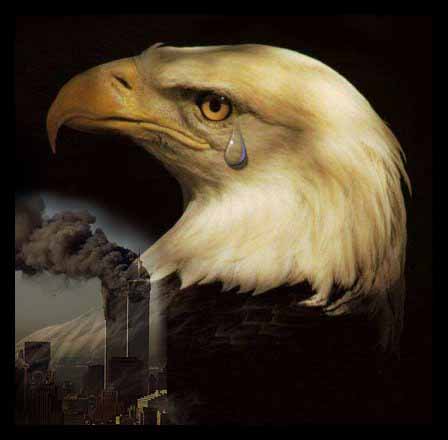
These colors still don't know how to run correctly


Ten Years Later

IEF | On a Day of Remembrance for Fallen Heros

9/11, ten years later. Ten years of terror and counterterror—ten years of innocent blood—and the nightmare finally appears to be over. Osama is dead, the war is won[1], and most importantly, a new wave of resistance is sweeping the globe, a resistance that has nothing in common with the terrorists or their enemies. If the most nightmarish aspect of the last decade was its unreality—a dream-world corpse-machine—today's struggles are striking because they are real. This is the moment we have waited for: a moment without distractions, a moment ripe for revolution. And yet, perhaps there is a lesson still to be learned before we close the chapter.

At one level, at least, the terrorists did win. Nobody today thinks of exporting democracy. Not only democracy, but the whole idea of a smooth space of cultural exchange has been thrown into confusion. Without this idea, which was always utopian, it is difficult to believe in the neutrality of the market; at an intuitive level, the "economy" loses its self-evidence. Not that this implies any sort of anticapitalist groundswell. It simply generalizes the knowledge that capitalism is sustained only by continual war. One must be willing to die for the economy. And if not, one must find something else worth dying for. There are a thousand mechanisms for suppressing this knowledge—the attempted reconstruction of the soldier as a computational nexus, the surgical precision with which Osama was eliminated—but they cannot erase it. We saw it on TV.

The dirty wars of the eighties, like the terrorist attacks of the same era, were maintained at a subliminal level, as real events that could be represented or misrepresented, discussed or brushed under the rug by politicians and commentators. One saw the smiling face of Arafat or the Gipper, but not their hands. In our era—which revolves around 9/11 but began some years before—the opposite has been true. The events are their own representation. This was as true for the Seattle black bloc as it was for the embedded journalists in Afghanistan. The magic of 9/11, the sorcery that gave a symbolic act material consequences, was that it took this truth to its conclusions. By becoming a perfect image, it broke the stream of images, and thus broke the stream of events—of nonevents—as no mere event could do. The reluctant nihilist's apology for Al Qaeda, "At least they did something," reveals an unconscious understanding of this fact.

If propaganda is a visible lie pointing towards an invisible truth (if only the truth of consolidated power), pornography is a visible truth pointing towards nothing. The great propaganda event of our century was not propaganda at all. It was a pornographic nightmare that swallowed the world.

Towards the end of the decade, we active nihilists began to catch on. Against a depleted anarchism preaching "back to the community, back to the real," we radicalized the most unreal aspects of the summit protest. It began as secession from activism: do not seek affinity on the basis of political abstractions and their associated imperatives, but on the basis of shared conditions and the desires that inhabit them. Plan B was above all an organizational proposal, a proposal to establish affinity through the immediate gesture of attack. 100-200 = 1000. The exact texture and meaning of the gesture was ambiguous at first; eventually, through experimentation, it revealed itself as the pornographic. Invisibility did not mean merely evading detection, refusing communication; it meant a communication of meaninglessness. Although we did not find strangers spontaneously joining us in the street, we observed a certain resonance among worlds that seemed to make us stronger. This was the second secession: the social terrain of insurrectionary generalization became the image-world, in which spatial and temporal fragmentation mean nothing. "Shared conditions" ceased to mean physical or even social proximity; it meant the universal emptiness that our gesture revealed as act.

The difference between the terroristic strategy and our own had less to do with our squeamishness than with our rejection of professionalization. A central criterion for action: is it reproducible, does it promote or inhibit spontaneous antagonism? We articulated this tactical distinction as a matter of strategic principle, a gulf between ourselves and the theocrats. In retrospect, this was an exaggeration.

September 11 was a Hollywood production, with an executive producer and a massive corporate staff; with the advent of YouTube, Hollywood is passé. Ours is the age of participatory spectacle. Therefore, the tactical departure (or resuscitation) that we attempted was, rather than an internal development of the anarchist milieu, a selective reactivation of possibilities in adaptation to the times. A new iteration of capitalist sociability made a certain theoretical hypothesis realistic, and so we took the torch held out to us. Held out to us by terrorism. We were not the only vector of this historical transmission, but we were one of them. The result, which we witness in London as much as Athens, is a diffuse pornographic intelligence: Osama Spontex.[2]

Our own experiments eventually ran aground on the difficulties of sustaining a project that expresses itself only as emptiness. The secret thread of revolutionary commitment running from event to event did not matter at the level of our social reproduction or our material support base, for the simple reason that it was secret. We dispersed in various directions. Some formed communes, some got serious about Marx, some returned to building the anarchist movement. In every case, we took a step back from the extreme hypothesis. Without abandoning the insurrectionary strategy of rupture, we reinscribed rupture within a logic of continuity.

One might read this experience as a transitional phase in a continuing revolutionary progression. A nihilist moment was needed to clear out the vestiges of liberal, pacifist, and socialist compromise, so that a fighting movement could be reborn, a movement ready for the coming struggles. From a tactical perspective, the militant potential of the antiglobalization movement needed to be isolated and developed so that it could enter into new configurations: anti-austerity and anti-police struggles as the two fronts of tomorrow's class war. Maybe.

On the other hand, this return to bread and butter seems to resonate with a broader trend: the pacification of the image-world. When Greece burned in 2008, it was the European media, not the rioters, who talked of the "700 euro generation." The Greeks called themselves an image, an image from the future—and the generalization and success of the revolt (among Greek cities and towns, and also globally), was achieved at the level of images. In this respect, the more recent Egyptian insurrection was conservative, not only for its rapid recuperation by democratic demands and regime change, but also for its representation as secret, subliminal: everyone knows that what mattered is what happened in the street, away from the cameras; everyone knows about the media blackouts, the inaccessibility of truth. This gives credibility to an equally subliminal strategy for revolution, which limits attack to the real, to the explicable, to the truth suppressed by lies, to the antipornographic—a strategy that meshes seamlessly with the endgame of the counterterrorist decade. Namely, the return to normalcy of a system that digests and commodifies even the abnormal.[3]

The terrorisms will continue, with or without us, ever more diffuse. Certainly, the strategy of subliminal struggle will bear fruit, as surely as the activist strategies of the past. It will find its limit, though, in constructing a social body that can only normalize or exclude the spontaneous nihilism of our time. We do not want to repeat the spinelessness of our earlier excursion, nor do we want to democratize terrorism. But we are not content with this limit.


1 The continuing hostilities in Afghanistan have become yet another multilateral police action, more like Belgrade than Fallujah.

2 Mao Spontex denotes the attempt in post-68 France to elaborate the theory of revolutionary guerrilla warfare without reference to a centralized party-apparatus. Its intellectual expression is exemplified by writers like Deleuze, Foucault, and Guattari. Practically, it is supposed to have influenced (and learned from) the Italian Autonomia. The ideas seem to have affinity with the Invisible Committee's idea of the Party, which (incidentally) also references anomic violence in the terrorist manner.

3 "We didn't do it for the lulz." Anti-austerity is a political abstraction inviting a new activist imperative. It differs from the old anarchist abstraction only in presenting itself as concrete, economic, specific to the times. Anti-austerity action without an anti-austerity ideology might be another matter. Whether or not that's a good idea is another question.


Tuesday, December 8, 2009

Oh yeah, We made a book


The Institute for Experimental Freedom (IEF) is proud to release the little book: Politics is not a Banana: The Journal of Vulgar Discourse, What are you Doing After the Orgy or Insurrection or Whatever?

From the introduction:

The insurrection has not transformed our rotting teeth into pure indestructible diamond grills. The orgy only spreads our combined STDs, unless we cover our filthy used bodies in saran wrap—which is pretty cool. Whatever; we made more than $6.50 plus tips but then blew it all on wine, cigarettes, rope, and ceiling hooks. The insurrection gives us this opportunity though, to forget, to practice, and even to run up on some doctor and force his medicalizing ass to nurse our irrevocable rot; to re-imagine our relationships with our stupid dying bodies. It makes us become attentive to the force of our little deaths and the inexhaustible desire we can embody.


The book is a collection of texts, images, and design sensibilities which combine insurrectional theory, critical theory, and post-structuralist inquiries about power and subjectivization with experimental fiction, flarf poetry, Brechtian pornography, and Swiss-influenced post-ironic typographic design.

Following a strange popularity of the '07 printing of Politics is Not a Banana 7x7 journal, the IEF put out a call for submissions for another issue. Contributions were overwhelming, and resulted in our decision to print this beautiful magenta 4.25x6 book/textual war-machine.

Contributions range from the IEF's own Liam Sionnach and Maxamillion Stihl, to new English translations from the collectively written French journal Tiqqun, to a lesser known French group “The Enlightened Avant-Garde” (aka The Movement for the Apocalypse of Montpelier) to Parser's Magazine's Robert Farr flarf poetry to Wax Poetic's own Idris Intifada.

Distributors and Bookstores Get in touch for wholesale prices or use the order form at the bottom of the post.


Politics is Not a Banana is currently available in the US at:

Firestorm cafe and books in Asheville, NC

Internationalist Books in Chapel Hill, NC

Blue Stockings in NYC

Book Thug Nation in Brooklyn, NY

Spoonbill and Sugartown in Brooklyn, NY

The Cream City Collective via Burntbookmobile, in Milwaukee, WI

Sporeprint Infoshop in Columbus, OH

City Light Books in San Francisco, CA

Modern Times Books in San Francisco, CA

Needles and Pens in San Francisco, CA

Bound Together Books in San Francisco, CA

Online Distributors:

Little Black Cart

Last Earth Distro

(this post will be kept up, and updated as new locations come in)


Order the damn book!!!!!1!


Politics is Not a Banana | What are you doing?...
Email for media mail options


Also, who likes reading books online and printing terrible bootlegs?
[aka: readable Politics is Not a Banana | What are you doing...? PDF on issuu]


Oh and by the way, in part because our absurd negligence, and in part because of riseup.net's low file space, some contributors may not have received a copy of PNB in mail, please email us if you contributed and have not received a book. We'll totally make it up to you, if you know what I mean.

Sunday, December 6, 2009

Get Paid | Wil' Out | Push the University to Crisis


Here's a recent post on infoshop which touched us in the most charming lumpen-bourgeoisie ways. Although ruining the University financially through a sort of self-abolition of the student is quite a good start, we'd like to point out there are other means with which to elaborate this practice, and other ways which a university is occupied.

From infoshop news
Bankrupt the System, Exploit The University

The recent student struggles in California to transform their universities have been inspiring examples of what people can do when they come together, and begin to collectively believe in the future rather than fearing the threats issued in the present. Social wars need money, as Alfredo Bonanno (a 74-year old anarchist recently arrested in Greece for bank robbery) can attest to, and the university has put the gun in your hands. All you need to do is pull the trigger. Max out your credit cards, max out your student loans. Bankrupt the system that is bankrupting us!

All my life, I've been washing dishes, delivering pizza, bagging groceries, and hustling to make enough to pay rent. I've always been a working class, Joe "The Plumber" Wurzelbacher kinda guy. You betcha!

In the past, I've dumpster dived, telling myself it was because I wanted to. But really, I would've preferred to eat the fresh food in the store. I did it because I didn't want to waste away my entire life in that hot, wet, greasy dishwashing room. I did it to be able to save up money so I could quit my job and travel before I became a shriveled up old prune with arthritis, whose only way to see the world was using an RV, something that I would probably never be able to afford.

Anyway, I got into some shit with the law, you know the deal. The cops love to make their quotas. It was military, prison, or college and some time on probation for me. I applied to college solely to save my own ass, not for some stupid degree that I can present to a potential boss for the "opportunity" to spend the next decade kissing his ass.

College is a social structure full of the privileges the state gives to the middle class. No one ever explained this dope ass scam to me before! My parents didn't go to college, they didn't know what the deal was. No wonder you middle class students are so content, I'd think to myself. No wonder you didn't want a revolution.

Well, now that some of you do, or at least you know there needs to be some serious changes because the system is breaking down, it's up to you to pull those triggers.

This is a call for all students to take full advantage of the benefits the middle class is offered through the university. To bet on the future and not on the present: to take out as much money in student loans and credit cards as you can, with no intention to pay it back.

read more...

Wednesday, September 16, 2009

DOOM$DAY WAR MACHINEZ | a Quip from a lil' Wildness in the Midwest

Thanks to MKE comrades for this charming report back

On September 11th 2009, a slew of miscreants from all corners of the insurrectional constellation descended on the University of Milwaukee campus for a lovely evening with the IEF's own Liam Sionnach. While being fed grapes and smoking indoors (naughty, naughty) The Institute got differently-abled on profanation, the end of time and the human strikes of our disease ridden bodies. The room may have gotten wrecked a bit, chairs may have gained flight, everyone may have shared a lick, and a speaker may have been pied. It is all a blur by this point. What is certain: some folks in Milwaukee definitely got a stern-talking-to by their landlords, we practiced a trans-geographic sharing of complicities and bodily fluids, offered the gift of enmity (served cold in bottles) to some frat boys, and of course articulated our favorite gesture; sadomasochism. Oh, and we're also probably never allowed back at a certain luxury hotel in downtown Milwaukee.

THE INSTITUTE FOR EXPERIMENTAL FREEDOM 2009 TOUR:
come for the commodities, stay for the strip-searches.


1. How does it feel to be never alone, every-so-often?

Last week in the Midwest we continued a process which can only be called “beginning again”. Either because we occupy the position of being an active minority of proletarianized life, or a profoundly bored minority of proletarianized life. We are captivated with finding, and sharing each other. Perhaps a certain textual promiscuity, and a certain seductive distance brings us together. Perhaps an invisible voice acted on us collectively, and perhaps we simply like the similar clothes, music, and inside jokes. Either way, let's not reduce what could grow and become stronger by claiming to be the insurrectional queer, power-hungry, bro'd out, mean bitchez, that we also are. But let's hold on—without forgetting where the boundaries of exclusion are, which we are setting out—and keep losing ourselves in the thresholds.

2. The Other Means of War

What would it mean to engage in methods of conflict and even combat which reveal how it is done? And yet, how could this be invisible? These are some of the challenges which face the contemporary insurrectional project. The intimate event appropriates us—makes us the technologies of whatever force it may wield. How an event is populated and practiced gives it its form. If the content of insurrectional events is defined only by the intimacy between a small group, then it is far more likely that the specialized division of labor relation which alienates us daily will be replicated. On the other hand, if we engage in an open discourse of conflict, a certain potency which is located in becoming sensitized to each other's shared desire can be lost.

Of course there is a tension between experiencing hostility (unknown, outside) with new people and place, and experiencing friendships. We are not trying to become secure, or reject the hostis—which is the foundation of all relations. However, the construction of a partisan war-machine of insurrection requires that we face, and practically answer these questions. How is the rhythm of our shared-time—the history of social war—felt beyond the confines of what happens between our bodies (communication), how is is felt as what affects us—what we are taken by? How is this achieved without a protest-media strategy? Are there voyeurs within the immediate vicinity of a given gesture of insurrection who will be seduced by our gifts? If the answer is “no,” then we must either face the fact of singularities, which happen as mere representations with affective faculties (the one-off event which sucks everything into its vortex) , and/or seek out, occupy and if we have the capacity impose new topographies which we are better suited to populate with affects (the consistency of ungovernable terrains—occupied workplaces, schools, and social spaces which generate material solidarity and portals into our worlds).

3. Dispossessed are Turning to Communism/Violence

If we are turning to communism in a world without it, it means we are immediately getting organized, collectively to improve our conditions. It means we will, one way or the other, find ourselves in combat. A crass provocation: get money and power by all means. Some still want to continue their projects which help others. Cool. Others want to be able to live and fight. Both need money, and positions which we will defend.

On the other hand, how is violence shared? How are the spaces which we inhabit combustible? This week proved two weaknesses: 1.) We are not currently positioned to attack those whose bodies have been structured as military-machines. 2.) We are still afraid to start shit (perhaps, reasonably). Quite literally, the man with dog tags is better at manning-up than we who perform tough. Perhaps reclaiming force will have to take place a different level. Other material forces who perform being tough and mean are better situated to start shit and bully. Perhaps if we are going to locate a biopolitical sadism, it must happen along side a biopolitical masochism. But who wants to get hit first? Or rather, how will we hit first?


For those of you coming to get B-A-N-A-N-A-S in PGH, we'll see you in the Thug Section. Others, perhaps we'll continue to find out if we've reached our expiration date in the Spring.


Whats another word for "The partisan War Machine of insurrection?"

Doom$Day” —or was it “Doomsgay?”


My neck, my back, my hipbones, and my crack, still ache so much, but at least I still have my shoes. How's your ass doing?
-Liam Sionnach | IEF | '09

ps:
If anyone was there and would really like a copy of the text, feel free to beg ief-southeast(at)riseup(dot)net.

Thursday, August 13, 2009

Politics is Not a Banana | "What are you doing...?" & new website, coming extremely soon (let's say September)


What are you doing after the orgy or the insurrection or whatever?

Politics is Not a Banana is at the printer. After some practical gestures to expose a plane of consistency for theory and practice, a few old questions posed from a different angle, a bit too much smoking inside, and an excessive use of typography, Politics is Not a Banana: “What are you doing...” has reached its threshold. Some 168 pages of content, color covers, off-set printing and 2-color-pantone insides as a perfect bound 4.25x7in assemblage will make up the machine of PNB. Around a thousand copies will be printed for the first run. Seriously, we don't even know a thousand people, much less a thousand people who will want to read this fucking thing.

“Politics is Not a Banana: What are you doing...” is not “Politics is Not a Banana 2.” While it is certain that the Politics is Not a Banana that has been floating around since spring of '08 was the first of many issues we have, it was not “Politics is Not a Banana 1.” This project is not intended for progress or development. If by chance we get worse over time, it is because we will have given in to the seduction of becoming a better commodity or a more terrible practice of print—which are temptations that are felt at every corner. If the former is the case, it would behoove you to not merely denounce us. If the latter is the case, may god have mercy on the anarchist milieu.

“Blablabla form blablabla content”

We believe that we can get what we want. Its difficult perhaps; we have to become sensitive to each other in order to really be expositional, rather than merely performative[1]. However, with a meaningful practice of doing relationships how we want to, we may accidentally stumble upon something a bit better than just a different form of terrible. It is this logic that motivates the experiment with the commodity known as Politics is Not a Banana.

The Institute for Experimental Freedom would like to congratulate itself. We engage in projects with a certain lightness and prefer the form of the experiment, which serves to prove—to give experience—to a what we believe to be sensible. If the 7x7 issue of Politics is Not a Banana proved anything, it was that the practice of DIY print (zines) could be reappropriated. Solidarities between service workers felt as inclinations were made material, and whatever force of seduction was afforded to Politics is Not Banana translated into crews across the US figuring out their own shit and printing a few copies. The theft and use of the hookup network between various metropolitan service workers made the initial 300 copies of Politics is Not a Banana possible. The use of the information super highway and the PDF form accounts for the other immaterial conditions which gave Politics is Not a Banana its strangely vast distribution. The practice of so called DIY print is not dead, it is merely refined.

Cool.

Despite the fact that Politics is Not a Banana “What are you doing...” was professionally printed, it should not to be understood as form in favor of content. Rather, it is an elaboration of the methods employed to produce the glossy pages and the design decisions of the first issue that tormented Anarchy Magazine. Should we pay from our own pockets to produce beautiful things that will be captured as commodities? Never. Although, sometimes we do. This time, however, like the last, is a testament to what is possible through a profaned use of class antagonisms, friends, sadomasochism, a few hoops to jump through, and, of course, material solidarities. Although currently we shamefully practice doing the commodity ethically or whatever, perhaps soon we'll give the purists a real reason to hate us.

Don't mistake cohesion and rhythm for a coherent political program. Although some readers will applaud a more easy to follow amalgamation of texts, Politics is Not a Banana “What are you doing...” is not the result of ideological unity between contributors. After carefully reading the proofs, the editors of Politics is Not a Banana turned to each other and shared the tiniest single tear for the undoubtedly stupid readings of our so-called work of art. Yes, we could have more effectively splayed aphorisms and nonsensical maxims across the page; we could have interrupted the reader with more confusing pornography, with more experimental fictions, but then again we, so charitably, decided to cut a lot of our own writing. Perhaps we can all learn a valuable lesson: there is more to the practice of radical discourse than propaganda and discipline. Make no mistake, we could give a fuck, and we certainly do give fucks, but our perversity cannot be contained in any one literary singularity. We take whatever seriously.

So how will we distribute this? How will we share our shame and power? How will we write our ignoble desire on new generations?

We have no illusions about the class composition of our friends and comrades—we work stupid jobs and survive on coffee and theft, but we're pretty good at it. Likewise, we have no fucking idea what to do with a thousand copies of anything. When anarchists give us their newspaper advertisements for this or that protest, we are usually able to get rid of like twenty and then the rest usually sit around. Sometimes print is lucky enough to be used for kindling. Most times, it's near a toilet. “Politics is Not a Banana: What are you doing...” is useless as toilet paper. It is best as a sexual technology or fashion accessory.

It is from this knowledge that we pose the question to our comrades, to our vile territories of revolt-in-practice. We will be selling Politics is Not a Banana at a retail price (around $10-12) and a wholesale price (around $5-6). We ask that comrades buy fifty or so at wholesale and then sell it to make a reasonable amount of profit to benefit their projects; we ask that distributors get in touch too, but we're not super worried if Glenn Beck doesn't cry about us on Fox news. We ask also that comrades in university and comrades who work with social spaces would be so kind to get in touch with us, to prepare this year's IEF tour (SRSLY IEF T0URz 0MG!!!!1).

Nothing is too beautiful for the unwanted children of capital,

-IEF friends

from the dirty, and across the puddle '09


[1.] the poke at performance here is not meant as a denouncement of all things performative—in the world of lies, it is useless to tell the truth—rather it is meant to critique a vulgar logic of advertising that is applied in many contemporary radical projects. We want to become sensitive to each other in order to lie together.

PS: Our sincerest apologies to those who did not make the cut—you gotta want it more. To those who sent us an email saying, “Do with this what you want.” we must reply: this is neither submission nor cruelty, it is merely feigning indifference. Perhaps the shame you feel should motivate you to redeem yourself one way or the other?

PPS: www.politicsisnotabanana.com


Some gems from inside the typographic war-machine:

Public Sex and Social War

An examination of the orgy and public sex as a biopolitical strike aimed at dissolving the categories of “public” and “sex.”

I am a Bulging Tangle I am a Stringy Mass

A pornographic critique and analysis of anarchists election year strategy using Baudrillard and Antonio Negri (Oh, my!), featuring an Inhuman violation of Barack Obama.

O.K.

An IEF Favorite. Two communiques from the Enlightened Avant-Guard regarding the “so-called anti-CPE struggle,” featuring their “politically coherent propositions” (PCP).

Taking Communion at The End of History

An elaboration of the theories of rupture, divine violence, and insurrection and a critique of the dual power revolutionary strategy using Agamben, Tiqqun, Miranda July, Walter Benjamin, and Pasolinis' Salo 120 days of Sodom.

The Revelation of St Narcissus, with annotations by an Yadira Lopez, and a tangled mess of IEF critiques.

A critique of the anarchist identity using a framework of the Situationist Internationale's critique of the image.

Biófilo Panclasta: Lover of Life, Destroyer of Everything

The first English language biography of the Colombian anarchist Biófilo and his misadventures, poorly translated.

Horrible Sound Objects

A critique of the music form and elaboration of Takeshi Kosugi's gesture, alongside some provocative images of pandas doing naughty things.

The Heart of War

An elaboration of the theory of social war and a tactical contribution to the theory of Human Strike using Clausewitz and everyone's favorite utopian fascist, Carl Schmitt.

Oh Good, The War!

An English translation of the 1999 Tiqqun piece which examines the concepts of war, spectacle, and a redemptive concept of revolutionary time.